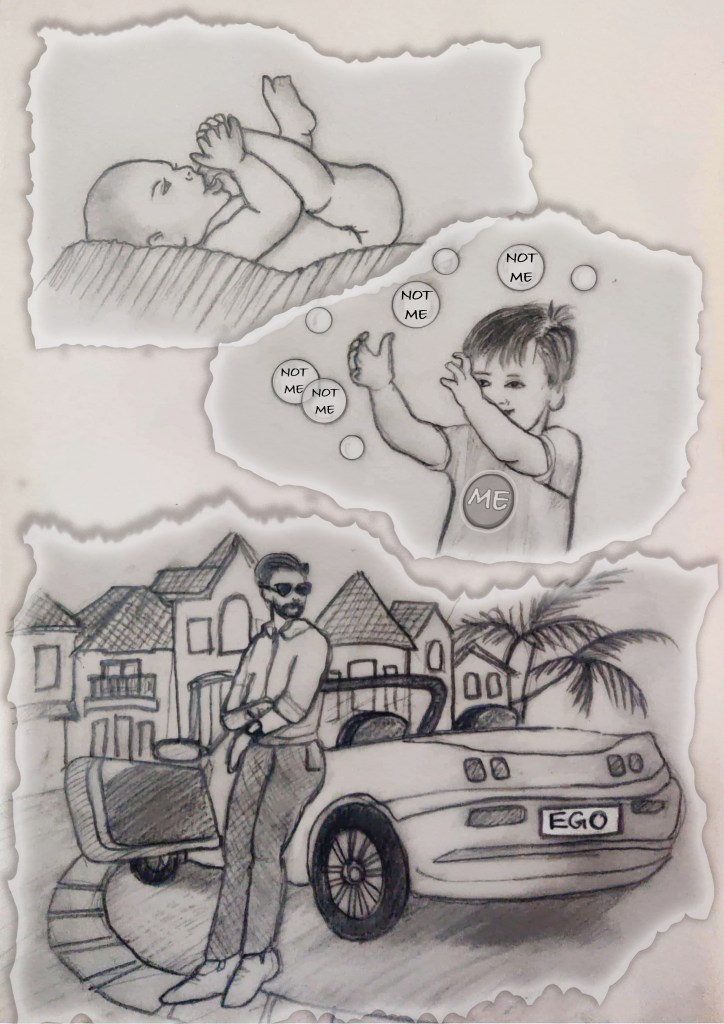
I was born naked. So were you. I came into this world without any possessions. I did not know who I was. I didn’t know if I was a plant, vegetable, or animal. I didn’t know what these were either. I couldn’t tell the difference between my big toe that I loved to suck and my mother’s breast until I discovered a “me” and a “not me.” I learned that some were nice, “not MEs,” and some not-so-nice. I knew that some “not MEs” were pleasurable, and some caused me pain; I learned to avoid those. I learned about pleasure and pain. I began to have “likes and dislikes.” I liked ice cream but disliked broccoli.
I grew some more and discovered that I was a “self.” I had a view of myself. I learned to defend myself. I was no longer just my body; I was becoming my ego. In my teens, I discovered girls I wanted to be friends with, but they liked boys with a good sound system and a record collection. I was envious. So, I got myself a good set of speakers with big woofers and started a record collection. My possessions began to become a part of me. I thought that the more I had, the more people would like me. I felt that the college I went to, the jobs, the car I drove, the home I lived in, and on and on defined me. From a naked child with no possessions and no sense of who I was, I was now my ego.
What exactly is ego? I spent many hours over many years figuring this out. Here is my take on it. Ego is at least two years younger than I am. I was not born with an ego. There was no sense of self until I was about two when I discovered the difference between “ME” and “not ME.” I was pure “ME.” No different than other “MEs” at this stage in their lives. There was no ego. Then, I started to have an expanded view of “ME.” I began to have pride in the family I was born into, the socioeconomic group I belonged to, the possessions I had, and even my thoughts and beliefs became a part of me. This expanded self was and is my ego. The ego is not a physical thing; it is a mental construct. The analogy that works for me is that of a Christmas tree. I started life as a simple tree cut from the forest; then, I started adorning it with trinkets and baubles until the original tree was unrecognizable. I was proud of all the pendants, and the actual tree lay hidden. The ornaments are a metaphor for the ego.
For the first forty years of my life, my self-worth and self-image were tied to the trinkets. I lived in a beautiful house in Malibu, I had a lovely wife, two perfect children, and a dog, but I did not feel fulfilled. There was an emptiness inside me. I was not happy. Perhaps, I was having a midlife crisis. But it was more than that.
I was not happy for sure, but why? I had done the pleasure-seeking, but there was no pleasure in it anymore. I could have tried drugs, but I did not. Instead, I chose to find out what makes a person happy. I sought books on happiness and emotions. I got familiar with the writings of psychologists such as Dan Seigel[1], Robert Plutchik[2], Paul Eckman[3], neuroscientist Dean Burnett [4]and New Age guru Michael Singer[5]. I had a new mission: to solve the problem of “ME.”
Rumi[6]
“You are a gem covered in mud and clay.
Your beautiful face is hidden.”
[2] https://en.wikipedia.org/wiki/Robert_Plutchik
[3] https://www.paulekman.com/
[4] https://www.deanburnett.com/
[5] https://untetheredsoul.com/
[6] Rumi translated by Haleh Liza Gafori
 Good God, It's Me!